엽서 정보
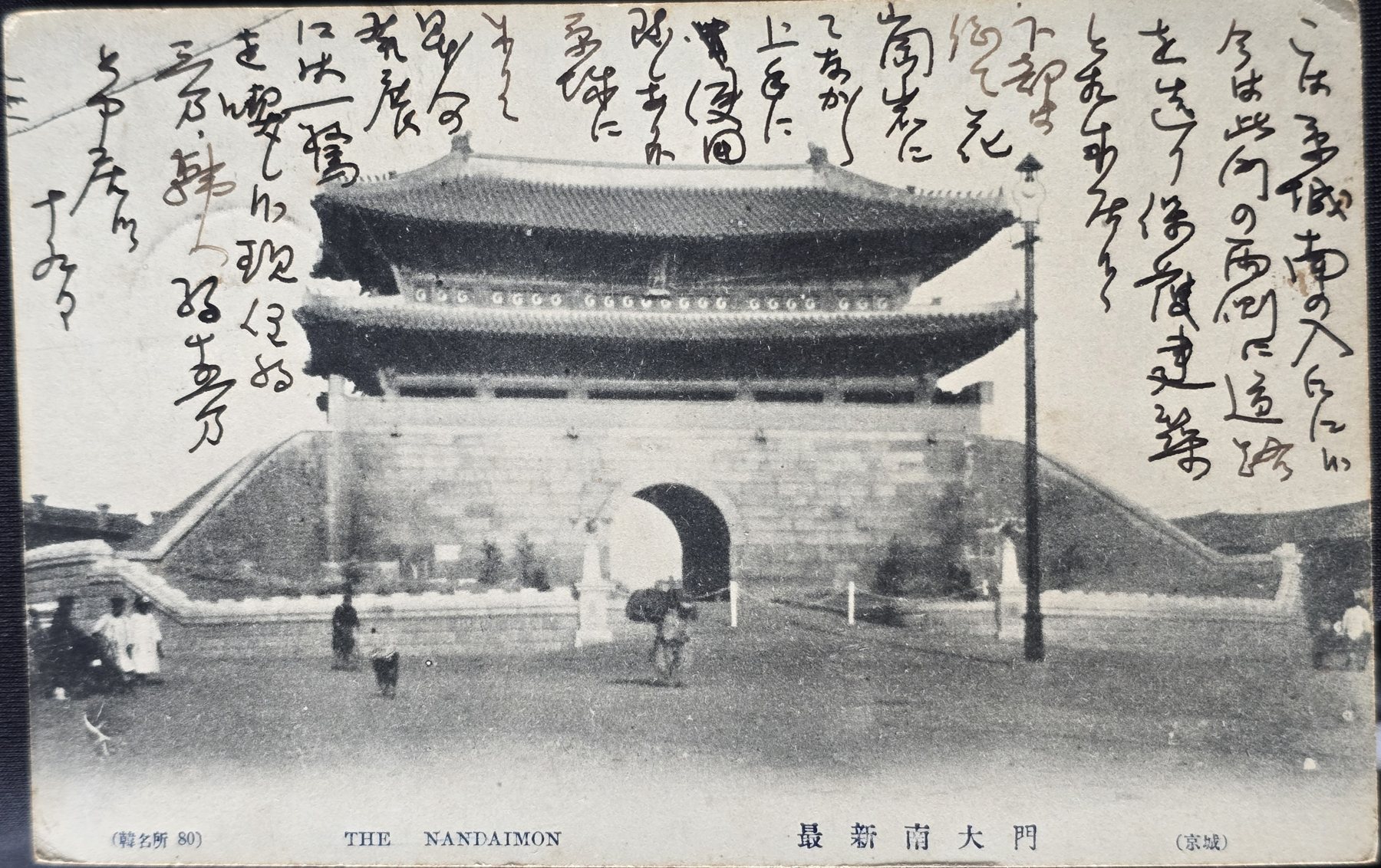
「最新南大門」, 한국 명소 시리즈의 80번째 엽서(韓名所 80)다. 발행처는 경성 혼마치(本町)의 '○○당'인데, 이름은 아직 읽지 못했다.
사진은 1907~08년 문 양옆의 성벽을 헐어낸 뒤의 남대문이다. 문 양쪽에는 경사진 석축만 남았고, 홍예 앞은 말뚝과 줄로 막혀 있다. 사진의 하늘에 일본인 발신인이 붓으로 적었다. "이것은 경성 남쪽 입구로서…", "지금은 이 문 양쪽에 도로가…"
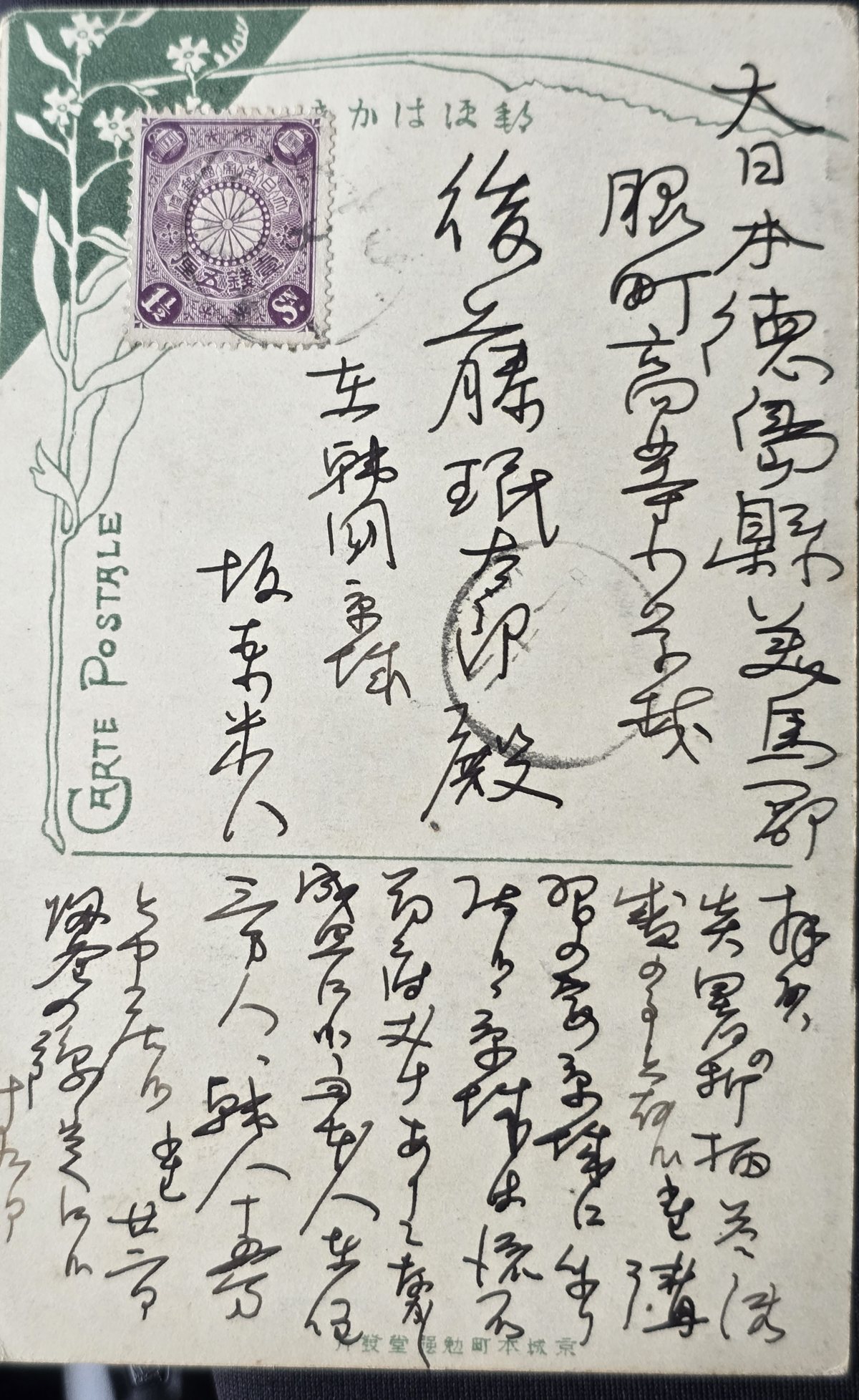
뒷면에는 보라색 1전 5리 일본 국화 우표가 붙어 있다. 발신인은 '在韓國(한국에서)'이라고 적었고, 받는 곳은 일본 도쿠시마의 한 고등소학교로 추정된다. 통신문은 '炎暑の折柄(무더위가 한창인 때)'로 시작하고, 소인 가운데에 '8'이 보인다. 성벽이 헐린 뒤이면서 '韓國'이라는 이름이 아직 쓰이던 1908~1910년 사이의 어느 8월에 부친 것으로 보인다.
앞면 셋째 줄, 뒷면 통신문 전체, 발신인과 수신인 이름은 아직 판독 중이다.
About the card
'Newest Namdaemun' (最新南大門), No. 80 in a series of famous sights of Korea (韓名所). It was published by a shop called '○○-dō' in Honmachi, Seoul; the name has not yet been read.
The photograph shows the gate after the city walls on either side were cut away in 1907–08. Only sloping stone ramps remain, and the arch is closed off with posts and a rope. In the sky above the gate, the Japanese sender wrote with a brush: "This is the southern entrance of Seoul…" and "Now there are roads on both sides of this gate…"
On the back is a purple 1½ sen Japanese chrysanthemum stamp. The sender signed from 在韓國, "in Korea", and the card seems to be addressed to a higher elementary school in Tokushima, Japan. The letter opens with a greeting for the summer heat, and an "8" can be seen in the middle of the postmark. It was probably mailed in an August between 1908 and 1910 — after the walls came down, while the name 韓國, "Korea", was still in use.
The third line on the front, the full letter on the back, and the names of the sender and the recipient are still being read.
김첨지 아내의 장례식에 참석한 덕보는 비통한 마음을 금할 길 없었다.
몇 년 전 식솔을 이끌고 한양으로 올라온 형님은 동소문 안 행랑채에 세를 얻어 살며 공사장 날품팔이를 전전하다가 인력거 한 대를 세를 내어 인력거를 끌며 근근이 생계를 유지하고 있었다. 조석으로 굶기를 밥 먹듯이 하던 터라 달포째 쿨럭이는 형수에게 약을 써 볼 엄두도 내지 못하더니 기어코 사단이 나고 말았다. 세 살배기 개똥이는 제 어미의 시신에서 떨어질 줄을 몰랐다.
덕보는 십여 년 전 형님이 시골에서 보낸 편지가 떠올랐다. 편지에는 측량기사들이 뒷산 꼭대기부터 마을 논두렁 구석구석까지 말뚝을 박고 다닌다고 적혀 있었다. 그 말뚝이 논뙈기를 부치며 살아가던 마을 사람들의 생계를 빼앗아 갈 줄 아무도 몰랐다. 땅을 신고해야 한다는 사실조차 아무도 몰랐다. 동네 어귀에 붙은 방을 읽을 줄 아는 사람도 없었다. 소작할 땅조차 빼앗긴 마을 사람들은 뿔뿔이 고향을 떠났다.
김첨지는 어째 이상하더라며 충혈된 눈을 끔뻑였다. 어째 운이 좋더라니... 하며 이미 시체를 씻고 옷을 갈아입힌 동네 사람들에게 여러 번 했을 하소연을 덕보에게 또 늘어놓았다.
어제는 아침부터 인력거 타는 사람들이 연거푸 나타나더니 저 멀리 남대문역까지도 다녀왔거든. 삯도 후하게 받았고... 간만에 친구 놈과 막걸리 두어 되 마시고 마누라 주려고 설렁탕도 한 그릇 사 왔는데 이 사람이 누워서 아무 말도 없는 거야. 운수 좋은 날인 줄 알았는데...
형님의 충혈된 눈에서 닭똥 같은 눈물이 떨어졌다.
덕보는 형님의 말뚝편지를 받았던 그해 경술년 여름을 떠올렸다.
* * *
쌀이 떨어졌다는 마누라의 바가지에 오늘도 아침을 굶고 집을 나섰다. 남대문역에 기차가 도착하자 덕보도 다른 짐꾼들처럼 개찰구 쪽으로 달려갔다. 마침 일본 사람 하나가 덕보에게 손짓을 한다. 큰 고리짝 하나와 가방 두 개를 지게에 싣고 덕보는 일본 사람을 따라 혼마치로 걷기 시작했다.
팔월 염천의 뜨거운 열기는 덕보의 이마와 등짝에 구슬땀을 흩뿌렸다.
남대문 앞에 이르러 덕보의 다리가 후들거릴 무렵 그 일본 사람은 남대문을 지그시 바라다보았다. 몇 년 전 성벽을 허물고 그 자리에 전차가 다니기 시작하더니 이제는 남대문은 길 한복판에 혼자 덩그러니 서 있는 고아가 되어 있었다.
일본 사람은 혼마치 입구에 있는 작은 점포에서 엽서를 한 장 고르더니 주머니에서 붓을 꺼내어 엽서에 뭔가를 쓰기 시작했다. 엽서에는 성벽이 없어진 남대문 사진이 박혀 있었다. 일본 사람은 엽서 뒷면이 모자라자 앞면 남대문 사진 위에도 빼곡하게 써넣었다.
혼마치 입구를 지나 진고개 쪽으로 조금 올라가서 혼마치 일본인 여관에 도착했다.
일본 사람은 주머니에서 은전 한 닢을 꺼내어 덕보에게 웃으며 건넸다. 오늘은 난까(뭔가) 좋은 날이니까...
은전 한 닢은 짐삯으로는 너무 큰돈이었다. 덕보는 고개를 깊이 숙이고 휑하니 자리를 떴다. 거슬러 달라고 말하기 전에 냉큼 자리를 뜨는 게 상책이었다. 일본 사람이 여관 안으로 들어가자 덕보의 얼굴에 웃음이 번진다. 오늘은 운수 좋은 날이군.
종로통 싸전에서 쌀 두 되와 과일전에서 참외 세 개를 샀다. 아내와 아들의 기뻐하는 모습이 눈에 어른거렸다. 종로통 네거리에 사람들이 모여 있었다. 벽에 붙은 방을 보고 어떤 이는 한숨을 내쉬고 다른 많은 이들은 무슨 말인지 읽을 수가 없어서 답답했다. 한 노인이 목소리를 가다듬고 소리를 내어 읽기 시작했다. "짐이 부덕하여...." 노인은 그만 자리에 철퍼덕 주저앉았다. 주변의 사람들은 뿔뿔이 흩어지기 시작했다. 네거리 건너편에서 총을 든 헌병 두 명이 이쪽을 노려보고 있었다.
그날 밤 참외를 나누어 먹고 덕보는 자리에 누웠다. 땀에 전 저고리를 빨며 아내가 말했다.
오늘 같은 날만 있으면 살겠네.
덕보는 웃었다. 정말로 운이 좋은 날이었다.
덕보는 이틀 뒤에야 알았다. 운이 좋았던 그날, 나라가 바뀌었다는 것을.
그리고 여러 해가 지난 뒤 알게 되었다. 형님을 고향에서 쫓아낸 그 말뚝이 결국 형수를 죽음으로 내몬 것을.
At the funeral of Kim Cheomji's wife, Deokbo could not hold back his grief.
His elder brother had brought his family up to the capital a few years before. He rented a servants' room off the gate of a house inside the East Small Gate and drifted from one day-labour job to the next on building sites, until at last he hired a rickshaw and scraped a living pulling it. Going hungry morning and night was so ordinary for them that he never dared buy medicine for his wife, who had been coughing for over a month. And in the end it had come to this. Three-year-old Gaettong-i would not leave his mother's body.
Deokbo remembered a letter his brother had sent from the countryside more than ten years before. It said that surveyors were going about driving stakes everywhere, from the top of the hill behind the village to every corner of the paddy banks. No one knew those stakes would take away the living of villagers who farmed their scraps of rice land. No one even knew that land had to be registered. No one could read the notice posted at the edge of the village. Robbed even of land to work as tenants, the villagers scattered and left home.
Kim Cheomji blinked his bloodshot eyes and said he had known something was wrong. "No wonder my luck was so good…" Then he poured out to Deokbo the same lament he must already have told, again and again, to the neighbours who had washed the body and changed its clothes.
From early yesterday the fares kept coming, one after another. I even went all the way to Namdaemun Station. Paid well, too… For once I had a couple of measures of makgeolli with a friend, and I brought home a bowl of seolleongtang for the wife — and she's lying there, not saying a word. I thought it was my lucky day…
Big, heavy tears fell from his brother's bloodshot eyes.
Deokbo thought back to the summer of the Gyeongsul year, the summer the letter about the stakes had come.
* * *
His wife had grumbled that the rice was gone, so once again he left home without breakfast. When a train pulled into Namdaemun Station, Deokbo ran toward the ticket gate like the other porters. Just then a Japanese man beckoned to him. Deokbo loaded a big wicker trunk and two bags onto his A-frame carrier and set off behind the man toward Honmachi.
The blazing August heat scattered beads of sweat across his forehead and back.
As they reached Namdaemun and Deokbo's legs began to shake, the Japanese man stopped and gazed quietly up at the gate. A few years earlier the walls had been torn down and trams had begun to run where they once stood. Now Namdaemun stood alone in the middle of the road, an orphan.
At a small shop at the entrance to Honmachi, the Japanese man picked out a postcard, took a brush from his pocket and began to write. On the card was a photograph of Namdaemun without its walls. When he ran out of room on the back, he filled the picture on the front as well, right over the gate.
They passed the entrance to Honmachi, climbed a little way toward Jingogae, and arrived at a Japanese inn.
The man took a silver coin from his pocket and handed it to Deokbo with a smile. "Today is — nanka — somehow a good day…"
A silver coin was far too much for carrying bags. Deokbo bowed deeply and hurried away; better to be gone before anyone thought of asking for change. As the man went into the inn, a smile spread across Deokbo's face. Today is my lucky day.
At a rice shop on Jongno he bought two measures of rice, and at a fruit stall three Korean melons. He could already see his wife and son's delight. At the Jongno crossroads a crowd had gathered. Before a notice on the wall, some sighed; many more could not read it and stood there helpless. An old man cleared his throat and began to read aloud. "We, lacking in virtue…" Then he sank to the ground. The people began to scatter. Across the crossroads, two military policemen with rifles were glaring their way.
That night, after they had shared the melons, Deokbo lay down. Washing his sweat-soaked jacket, his wife said:
If every day were like today, we could live.
Deokbo laughed. It really had been a lucky day.
Only two days later did Deokbo learn that on that lucky day, the country had changed hands.
And only after many years did he understand that the stakes which drove his brother from home had in the end driven his sister-in-law to her death.
맺음말
역사 속에서 덕보나 김첨지에게는 나라가 없어지는 것보다 먹고사는 게 더 중요했습니다.
덕보의 운수 좋은 날이 백 년 뒤 우리에게는 국치일이 되었습니다. 김첨지의 운수 좋은 날은 나라 잃은 백성이 필연코 마주치는 운명이었습니다.
나랏일하는 무리들의 이전투구에 식상하여 저녁 뉴스를 대충 넘겨 보는 우리도 그날의 덕보나 김첨지가 아닐지 생각해봅니다.
김첨지와 개똥이는 현진건의 단편소설 「운수 좋은 날」(1924)에서 빌려 온 인물입니다.
Afterword
In history, for people like Deokbo and Kim Cheomji, putting food on the table mattered more than the loss of a country.
Deokbo's lucky day became, a hundred years later, our Day of National Humiliation. Kim Cheomji's lucky day was the fate that a people without a country could not escape.
Tired of the endless squabbling of those who run the nation's affairs, we skim past the evening news. I wonder whether we, too, are Deokbo and Kim Cheomji on that day.
Kim Cheomji and Gaettong-i are borrowed from Hyeon Jin-geon's short story "A Lucky Day" (운수 좋은 날, 1924).
The Gyeongsul year is 1910. Japan's annexation of Korea was proclaimed on 29 August 1910; Koreans remember the day as Gukchiil, the Day of National Humiliation. English translation drafted with AI assistance.